


This week in The Legibility Letter:
• The Jenatzy commission: in 1897 a workshop that had spent ninety years making carriages built the body for the machine that would end its trade — the time to build the next thing is while you still don’t need it (and it always looks like a distraction rather than an opportunity)
• From the inside: confidence isn’t a personality trait, it’s infrastructure — without it every win is an isolated event, with it every win compounds
• A quote we like: I’ve taken shelter in unquestionable answers that settled me and narrowed what I could see — an answer you can’t question leaves you comfortable, a question you can’t answer keeps you alive
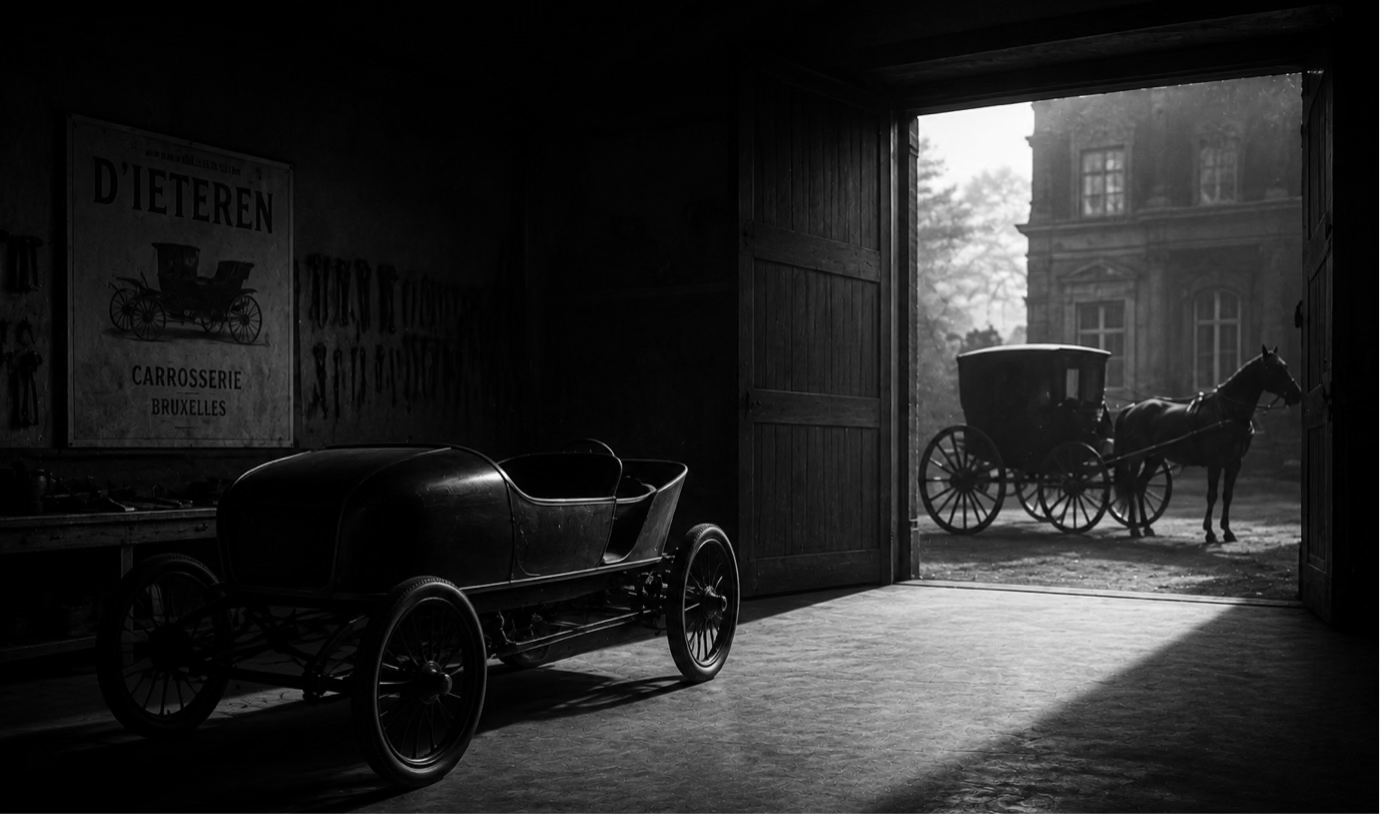
The Jenatzy commission
On 31 December 1897, the D’Ieteren workshop delivered a body for an electric cart. The customer was Camille Jenatzy, a Belgian racing driver who two years later would become the first man to pass 100 kilometres an hour.
The workshop had been making horse-drawn carriages for ninety years. Medals at international exhibitions and, since 1887, a royal warrant from the Belgian court.
They were at their peak. And that day they built the body for the machine that would end their trade.
The two brothers
D’Ieteren began in 1805 as a wheelwright’s workshop in Brussels. Today it turns over more than €8 billion and is still in the hands of the same family, seven generations on.
Along the way: carriages, bespoke coachwork, importing Studebaker in 1935, exclusive Volkswagen distribution in Belgium from 1948, and in 1999 the purchase of Belron, the world leader in vehicle glass repair.
In the 1920s, Lucien D’Ieteren already knew that the mass-produced American car would finish off handmade coachwork. It took him fifteen years to act, and the 1929 crash gave him his excuse. His brother Albert bet the other way and stayed with the craft.
Albert’s company eventually closed.
The time to build the next thing is while you still don’t need it.
What looks like a distraction
The problem is that this moment never looks like an opportunity. It looks like a distraction.
It’s the strange request a client makes that doesn’t fit your catalogue. It’s the tool you’d have to learn and don’t need right now. It’s the small line that brings in 4% of revenue and all of the interesting conversations.
When business is good, you say no to all three. And the no comes with good reasons behind it: focus, priorities, not spreading yourself thin.
The trap
In 2016 D’Ieteren bought Moleskine, the Italian notebook brand, in a deal that valued it at more than €500 million. On the day of the announcement Moleskine shares rose 13% and D’Ieteren’s fell by as much as 7.3%. Analysts couldn’t make sense of it.
Nine years on, Moleskine turns over around €140 million. In 2025 it posted a loss for the half-year and the group had to write down the value of the brand.
The analysts were right.
In 220 years, almost every move the family made had been one step sideways: wheels, carriages, coachwork, importing cars, glass, parts. Each one held on to the one before it. Moleskine held on to nothing.
And that is exactly what happens when you build the next thing with too much money behind you. A surplus makes everything look reachable, and reachable isn’t the same as connected.
Think about the next thing you are considering adding.
Don’t ask whether it’s a good idea. Ask what it holds on to, what you already do that makes it possible. If you can’t name it, it isn’t a step. It’s a jump.
Confidence
I was working with my daughter recently, helping her get to grips with basic mathematics. And at some point I noticed something that completely changed how I saw what we were doing.
The problem wasn’t her understanding of mathematics.
The problem was that she needed to believe she could learn it. She needed the confidence of knowing that if she practised, she would understand. Without that confidence, the numbers didn’t matter. With it, the numbers began to make sense almost on their own. Building her confidence mattered more than teaching her the mathematics.
That moment brought me back to an idea I’ve been turning over for years.
Confidence is one of those attributes people tend to treat as something you either have or you don’t. As if you were born with it. Some people are confident, others aren’t.
It also gets treated as a soft skill, something secondary, not something people give much value or deliberate attention to.
The reality is that confidence governs far more than most people realise.
Anyone with practical judgement tends to know when they’re confident in a situation and when they aren’t, because they understand it goes straight to their performance. There’s nothing superstitious in that. It’s how performance works.
When you’re confident in what you’re doing, your ability to execute, to make decisions under pressure, to stay calm when things don’t go the way you expected, is fundamentally different from when you aren’t.
What I’ve learned is to keep calibrating how much confidence I have in a given area, in a specific situation. And where it’s low, to build it deliberately, using method rather than motivation.
Small wins that prove you can. Honest conversations with myself about what I know and what I don’t. Deliberate practice in the areas where the confidence isn’t there. Every small win becomes evidence. And accumulated evidence becomes confidence that no longer depends on anyone handing it to you.
And here’s the part that matters most.
You can get results without confidence. That much is true. A good day, a good opportunity, a lucky break can all produce an isolated result. But you can’t build a self-sustaining loop that pushes you upwards without working on your confidence.
The loop works like this: confidence improves performance, performance produces results, results feed confidence, and improved confidence raises the next level of performance. Each cycle builds on the last.
Without confidence in the system, every win is an isolated event. With it, every win compounds.
That’s the difference between someone who has good moments and someone on an upward trajectory. Not talent, not luck. One of them built the loop and the other didn’t.
What I saw with my daughter and her mathematics is the same thing I see in entrepreneurs, in athletes, in anyone trying to build something. Skill matters, strategy matters, effort matters. But underneath all of it, holding it up, there’s a layer almost nobody works on deliberately: the confidence of knowing you can learn, adapt and improve.
There’s nothing soft about that layer. Everything else is built on top of it.
Confidence isn’t a personality trait. It’s infrastructure.
Edward
“I would rather have questions that can’t be answered than answers that can’t be questioned.”
— Richard Feynman
I love this quote because it inverts what we usually value. It puts the good question above the settled answer.
In business we reward certainty. We want the definitive figure, the clear answer, the framework that explains everything. And we distrust ambiguity, as though not having the answer were a weakness. But Feynman, one of the most brilliant physicists of the twentieth century, preferred the discomfort of an open question to the comfort of a certainty nobody argues with any more.
Because an answer that can’t be questioned stops teaching us. It turns into dogma. And dogma is where thinking stops.
I’ve taken shelter in unquestionable answers. Certainties about my business that I repeated as absolute truths and that, precisely because they were unquestionable, stopped me seeing that the ground had shifted. The settled answer calmed me, and it narrowed what I could see.
Good questions are uncomfortable because they stay open, and they make us keep looking. But it’s exactly that openness that keeps us awake when everyone else has stopped thinking.
An answer you can’t question leaves you comfortable. A question you can’t answer keeps you alive.