


This week in The Legibility Letter
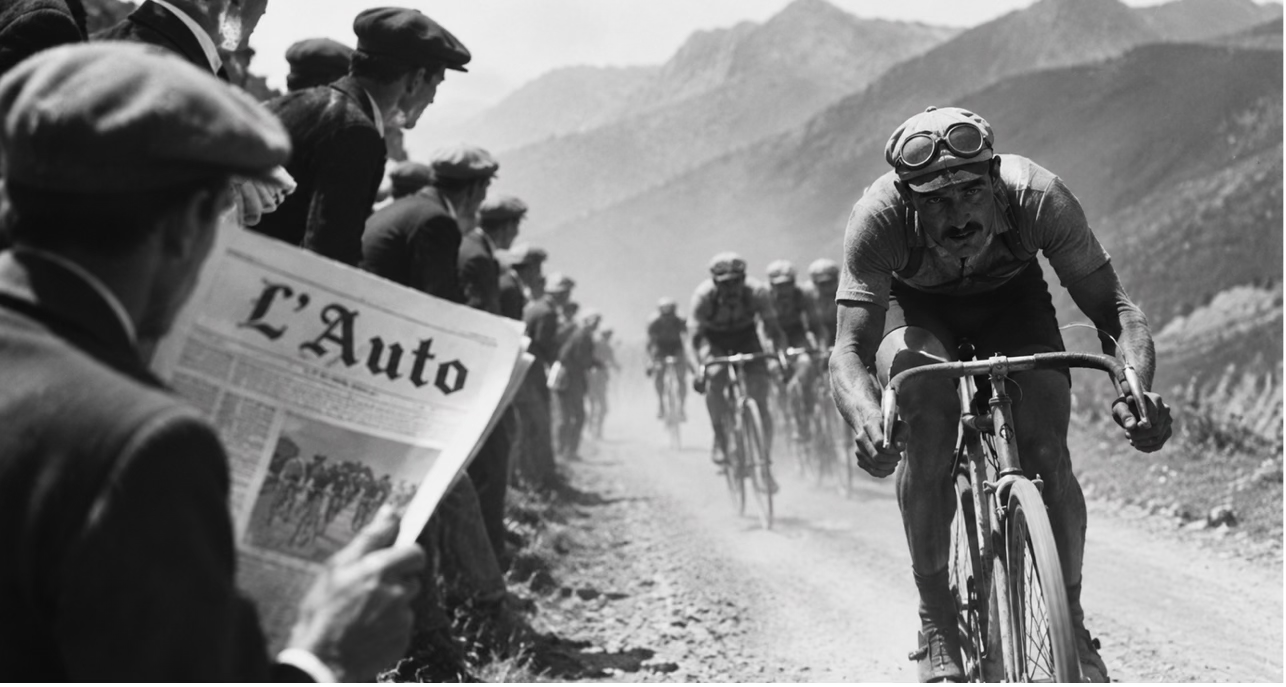
• The race a newspaper invented: in 1903, L’Auto was losing readers, so it organised a 2,428 km stage race around France — circulation went from 25,000 to 65,000, and the Tour is still being ridden 120 years later (the best advert is something people would follow even if you sold them nothing)
• From the inside: plenty of people can learn technique — the value sits upstream, in taste, judgement and having something to say (now that AI does the technique in seconds, what happens upstream is the one thing that can’t be automated)
• A quote we like: Wittgenstein put it as philosophy — the limits of my language mean the limits of my world (calling something “my little project” when it turns over like a company isn’t modesty, it’s a ceiling said out loud)
The race a newspaper invented
On 1 July 1903, sixty cyclists set off from a café in Montgeron, on the edge of Paris, to ride all the way round France. Nineteen days and 2,428 kilometres later, twenty-one of them made it back.
The race hadn’t been organised by a cycling federation or a town council. It had been organised by a newspaper that was losing readers.
From 25,000 to 65,000
The paper was called L’Auto, and its editor was Henri Desgrange. It was up against Le Vélo, an older and more widely read sports daily. And it was losing.
The idea came from one of its own journalists, Géo Lefèvre: a stage race around the whole country, lasting weeks. L’Auto organised it, and covered it every day in more detail than anyone else.
That summer, if you wanted to know how the race was going, you had to buy L’Auto. Circulation rose from around 25,000 copies to 65,000, and the special edition printed when it finished sold 130,000. By the following year, Le Vélo had gone out of business.
The Tour is still being ridden more than 120 years later. The paper that invented it is now called L’Équipe.
The best advert is something people would follow even if you sold them nothing.
Your Tour
Desgrange didn’t buy more advertising. He didn’t cut the price either. He organised something people wanted to follow, and the only way to follow it was to buy his paper.
A small business can do the same thing at its own scale. Picture a physiotherapist who, every Monday, sends patients a five-minute exercise for anyone who spends the day sitting down. A short video, no offers. A few months in, half the neighbourhood is doing it at their desks, and when someone’s back starts to hurt, they already know who to call.
The exercise isn’t an advert, and that’s exactly why people open it. If every Monday ended in an offer, they’d stop.
The trap
The risk is starting too big. The Tour was ridden in 1903, again in 1904, and almost every year since. That’s why it still works.
What very few people factor in is that you have to do it every time, including when you don’t feel like it. A newsletter often starts strong and dies in its third month. Nobody closes it; it just stops coming out.
Choose one thing your customers would follow even if you sold them nothing, and that you could do every month for a year. If you can’t commit to a year, it’s too big: make it smaller. This week, get the first one ready and put the dates of the next three in your diary.
People don’t follow adverts. They follow something that always turns up, and they remember who makes it.

Upstream
A few years ago in Lisbon, I started taking portrait photography lessons with Mário, one of the best fashion photographers in Portugal. I was expecting to talk about cameras, light and technique. Instead, he told me something I haven’t stopped thinking about: “Visual culture comes first. You can have all the technique in the world, but if you don’t have taste, if you don’t know what looks good, all you create is noise.”
I’d assumed a photographer’s value was in the technique. The reality is that plenty of people can learn technique. The value was somewhere else, further up.
Since then I see the pattern everywhere. Sometimes what creates the value isn’t what you’re selling.
Take writing. A lot of people get stuck on the quality of the prose: the nice sentence, the rhythm of the paragraph. AI now does that very well. If you don’t go upstream and ask whether you actually have something interesting to say, you’re creating very little value. The prose is the river. What you have to say is the source.
Sometimes the value is in something even harder to see. Every time I look at the results my business partner Alexandra gets with her clients, the same thing strikes me. It isn’t a particular technique, or a method anyone could copy. It’s her ability to hold the client’s whole business in her head and stay with them, constantly, to make sure they take the right next step. The client thinks they’re paying for a service. What they’re really getting is that presence.
I think we all have a value that’s ours alone, and very often it isn’t what we’re selling. It’s something that happens earlier, upstream: taste, judgement, what you have to say, the way you walk alongside someone.
So it’s worth looking at what you do and asking yourself honestly where the real value is. Especially now, when technique is becoming abundant. Whatever AI can produce in seconds stops being an advantage. What happens upstream doesn’t.
Sometimes what creates the value isn’t what you sell. It’s upstream.

“The limits of my language mean the limits of my world.”
—Ludwig Wittgenstein
Journalism taught me that words don’t describe reality, they frame it. Report the same story as a “crisis” or as an “adjustment”, and you change what the reader thinks is happening.
It took me years to see that business works the same way. And that the first reader of the words you choose is you.
There are founders who call something “my little project” when it turns over like a company. Who say “cost” where they should say “investment”. Who introduce themselves as “a small agency” and then can’t work out why they only get small clients.
That isn’t modesty. It’s a ceiling said out loud.
Wittgenstein put it as philosophy, but the effect is very practical: whatever doesn’t fit in your vocabulary doesn’t fit in your decisions either.
I’ve caught myself describing my projects, and even myself, in words smaller than they deserved. When I changed them, it didn’t just change how far I aimed. Paths appeared that I couldn’t see before, because I didn’t have the words for them.
Your strategy says where you want to go. Your vocabulary says where you’ll get to.